GEORGIA’S AMERICAN JOURNEY | Robins Air Force Base: A legacy of service and economic impact
From World War II beginnings to a $4.48 billion economic powerhouse, Robins Air Force Base continues to secure America’s freedom and fuel Georgia’s growth.
WARNER ROBINS, Georgia (41NBC/WMGT) — As America marks 250 years of independence, Robins Air Force Base in Houston County stands as a testament to the nation’s enduring strength and resilience. What began as a dairy farm is now one of Georgia’s most significant economic and military engines, with an impact that extends far beyond its gates. “We were preparing for war, even though the public didn’t realize it,” recalls Dr. William “Bill” Head, the base’s historian.
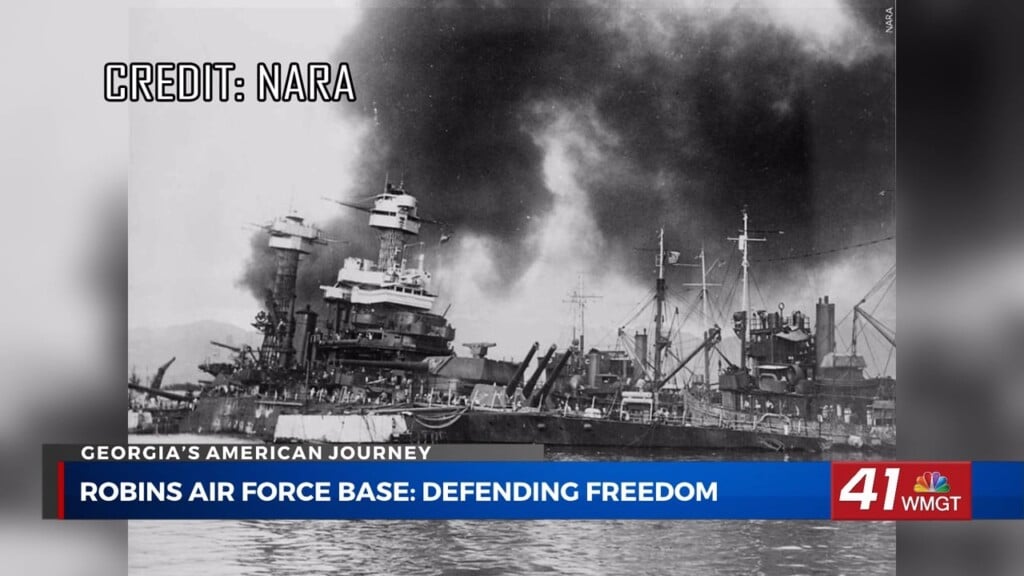
In 1941, with World War II intensifying overseas, a telegram from Congressman Carl Vinson announced that ground would soon be broken on a new airbase. The location was chosen for its proximity to the railroad, which made it ideal for moving military equipment quickly. Construction officially began on September 1, 1941, but the attack on Pearl Harbor just months accelerated the project.
“The war started in Pearl Harbor, December 7, and when that happened, everybody took it very seriously,” Head said. “They wanted to finish it, and by April of 1942, most of the buildings were built, the flight line was there.”
Originally, Robins was designed as a maintenance depot and cargo hub, but the mission quickly broadened.
“Anything that was in the area that needed it—even Navy airplanes, Corsairs coming up,” Head said.
Mechanics became multitaskers, repairing every kind of aircraft.
“Robins has always been a logistical kind of backbone of the Air Force, so it started as an Army Air Force maintenance and supply depot, and so almost every major airframe can be connected through their maintenance,” added Erin Tapp, Collections Manager at the Museum of Aviation.
By the end of World War II, the base had been renamed Warner Robins Air Technical Services Command. Yet, uncertainty lingered.
“By 1946, we’d gone from 24,000 people down to 3,900,” Head recalled, referencing the drastic postwar drawdown. In the decades that followed, rumors of closure surfaced again, but the community rallied to keep the base open.
Its influence became so prominent that, in 1980, the Museum of Aviation was established to preserve the U.S. Air Force history and honor aviation pioneers.
“The Air Force was born in 1947, and so we’re responsible for telling that heritage and that history piece, but we’re responsible for doing it here in Middle Georgia—connecting the fibers of southeastern history and Southeast aviation military history and mirroring it up to the greater Air Force Mission,” Tapp said.
Today, Robins Air Force Base remains a vital part of the Air Force warfighting team.
“We’ve been involved directly or indirectly in every major operation, even some minor ones, that the Air Force has carried out since World War Two, and all the way up till today,” Head said.
“Wow, just think of all the things that have happened since the beginning, and we didn’t know if we’d make it or not,” Head said.
Robins Air Force Base’s impact spans far beyond the city of Warner Robins, driving job creation, local business growth, and serving as a critical economic engine for the entire state. In 2025, base leaders reported the total economic impact of Robins Air Force Base was $4.48 billion—a number that underscores its importance to the Peach State and the nation.
This story is part of Georgia’s American Journey: 250 Years, a 41NBC series examining Georgia’s history and its lasting impact on the United States.
Click here to explore more stories, videos, and features from across Middle Georgia.