Trump’s lawyers appear before appeals court as he fights hush money conviction
By JENNIFER PELTZ and MICHAEL R. SISAK Associated Press
Key takeaways
- The appeal: President Donald Trump is asking a New York appeals court to overturn his May 2024 conviction on 34 felony counts of falsifying business records.
- Legal arguments: His lawyers argue prosecutors improperly relied on federal election law and that some trial evidence should have been excluded under presidential immunity.
- Prosecutors’ position: Manhattan District Attorney Alvin Bragg’s office maintains the case was legally sound and the challenged evidence was admissible.
- What’s next: Trump is also pursuing a separate federal appeal, with arguments scheduled for November 16.
- The outcome so far: Trump received no punishment at sentencing, but the conviction remains in place while his appeals continue.
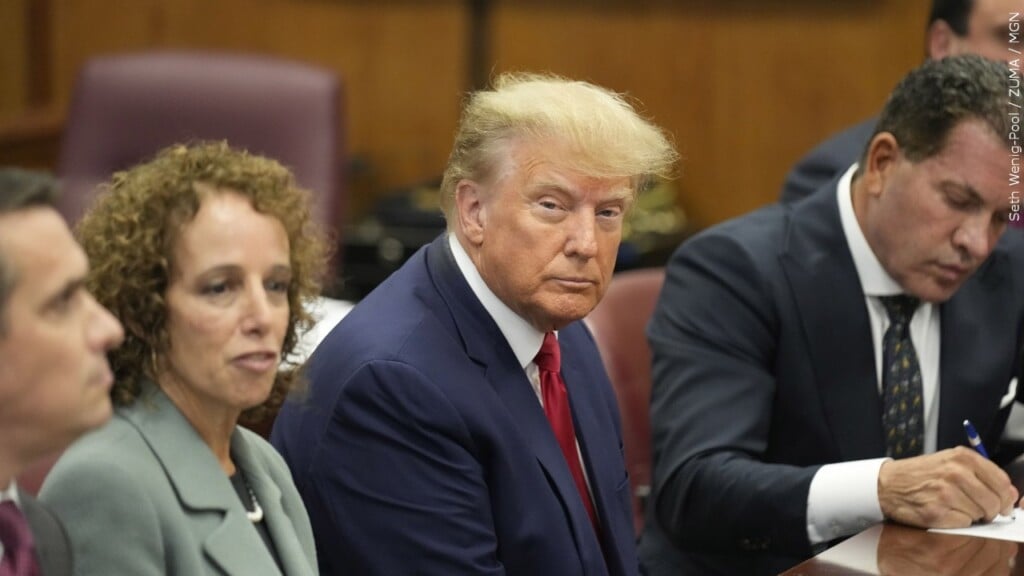
NEW YORK (AP) — President Donald Trump’s lawyers are trying to persuade a New York appeals court on Thursday to throw out his hush money conviction, two years after it made history.
The conviction, on 34 felony counts of falsifying business records to obscure a $130,000 payment to adult film performer Stormy Daniels, continues to nettle Trump enough that he denounced it on social media as recently as September. The president denies any wrongdoing, and he has turned to state and federal courts in hopes of unwinding the verdict.
He didn’t attend Thursday’s court session, where state appellate charges quickly started peppering his lawyer with questions about his argument that prosecutors’ legal theory was built on a shaky combination of alleged state and federal offenses.
The Manhattan district attorney’s office says the hush money was meant to keep unflattering information about Trump away from the electorate before the 2016 vote, and that it amounted to an illegal campaign contribution under the Federal Election Campaign Act. Trump lawyer Robert Giuffra Jr. told a panel of five New York appellate judges that state prosecutors have no place pinning a case on a federal election law.
“We think it’s the most obvious ground for reversal,” he said.
Prosecutors haven’t yet had their turn to speak.
The appeal also concerns whether jurors should have been allowed to hear testimony about supposed White House conversations, workflow and even Trump social media posts during his first term. His lawyers cite presidential immunity for official acts, and they argue his official conduct included responding to the Daniels drama once it became public in 2018.
“When a president addresses the nation to defend himself from allegations of personal misconduct (as all presidents do), or discusses such communications with his aides, he is carrying out his constitutional duties and is protected by immunity,” Giuffra wrote in a filing this October.
Manhattan District Attorney Alvin Bragg’s office counters that the legal theory and jury instructions were legitimate and that the White House-related evidence was fair game. Some was public record, some was a general description of office practices, and the conversations were “unofficial conduct,” prosecutors say.
“A president’s discussions about a purely private matter, even with a White House advisor, do not constitute ‘official acts for which the president is immune,’” Bragg’s appeals chief, Steven Wu, wrote in a filing in July. Besides, he said, there was “a mountain” of other evidence against Trump.
While the appeal turns on complex legal disputes, political overtones aren’t hard to find. The very first paragraph of one of the Trump team’s court filings contends the case was the flimsy product of “immense political pressure” on a Democratic prosecutor to go after Trump — rhetoric that echoes the Republican president’s own oft-repeated claims in the court of public opinion.
The May 2024 verdict made Trump the first former — and now current — U.S. president with a criminal conviction. While historic, it didn’t impede his return to the White House or subject him to any punishment.
The trial involved $130,000 that Daniels got from Trump’s then-fixer and lawyer, Michael Cohen, weeks before the 2016 election. The money bought, for a time, her silence about an alleged sexual encounter with the married Trump a decade earlier. He says that nothing sexual happened between them.
Trump’s company reimbursed Cohen in 2017, logging those payments as legal expenses.
Prosecutors argue that he “orchestrated a conspiracy” that violated federal campaign finance laws, among others.
Trump’s lawyers argue there’s only “weak” evidence that he even knew about Cohen’s dealings at the time. His trial attorneys also said that payments to Cohen were indeed legal expenses, and that any hush money expended on Trump’s behalf wasn’t hidden campaign spending, just an effort to avoid embarrassing his family.
The distinction matters because, under New York law, falsifying business records isn’t a felony unless it’s done with an intent to commit or conceal a separate crime.
While pursuing his state appeal, Trump also has been trying to shift the case to federal court and have it dismissed on immunity grounds. A federal judge said no — for the third time — in August. Trump’s attorneys are appealing that decision, and arguments on that appeal are set for Nov. 16.