


Keisha Lance Bottoms projected to win Georgia governor’s race, making history
NBC News and CNN project the former Atlanta mayor will defeat Republican Rick Jackson, becoming Georgia's first woman and first Black governor — and the first Black woman elected governor in U.S. history.
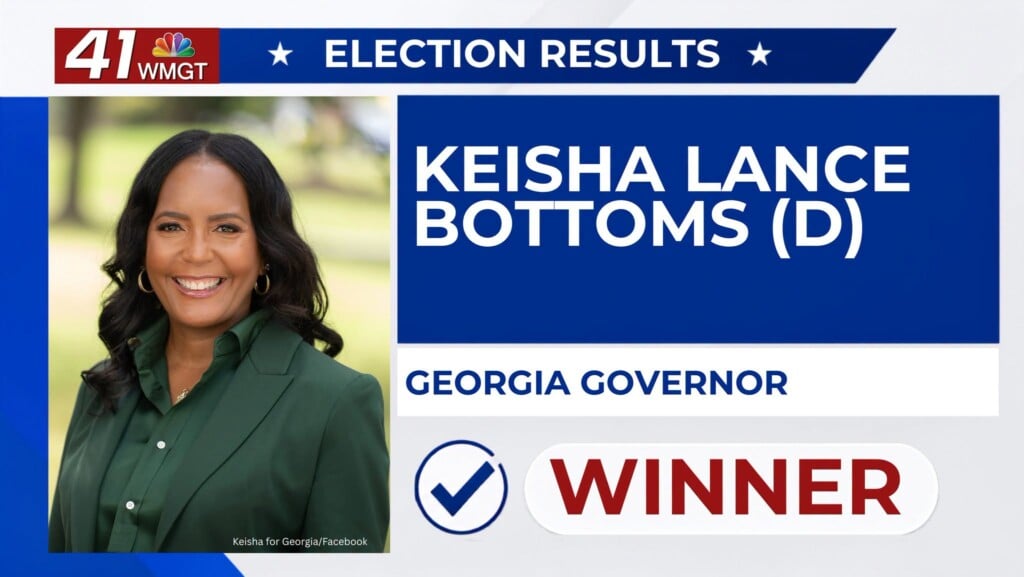
MACON, Georgia (41NBC/WMGT) – Former Atlanta Mayor Keisha Lance Bottoms is projected to win Georgia’s race for governor, marking a historic moment for the state and the nation.
NBC News and CNN project Bottoms, a Democrat, will defeat Republican Rick Jackson in the November 3 general election.
The projected victory would make Bottoms the first woman and first Black person elected governor of Georgia. She would also become the first Black woman elected governor of any state in the United States.
Three historic firsts
Bottoms’ projected victory represents three milestones in American politics.
Georgia has never elected a woman or a Black person to serve as governor. Bottoms would break both barriers when she takes office.
Her election would also mark the first time a Black woman has been elected governor anywhere in the country.
Bottoms previously served as mayor of Atlanta before entering the 2026 race for Georgia’s highest state office.
Bottoms defeats Republican Rick Jackson
Bottoms faced Jackson, a Republican businessman, in the general election.
The two candidates competed for the seat held by Republican Gov. Brian Kemp, who was unable to seek another consecutive term.
The projected outcome marks a change in party control of the governor’s office, with Democrats positioned to regain the seat after more than two decades of Republican leadership.
The projections by NBC News and CNN indicate Bottoms is expected to win the election, but the results remain subject to the official vote-counting and certification process.
Final certified vote totals and the margin of victory were not included in the information available for this report.
Democrat Keisha Lance Bottoms makes history as 1st Black woman to be elected Georgia governor
ATLANTA (AP) — Democrat Keisha Lance Bottoms has made history as the first Black woman to be elected governor of Georgia, defeating Republican businessman Rick Jackson on Tuesday and flipping the top job in a key swing state.
A former Atlanta mayor, Bottoms won Tuesday despite a staggering campaign spending deficit driven by the billionaire Jackson tapping more than $200 million of his own fortune. She becomes the first Democrat to prevail in a Georgia governor’s race since 1998.
“What we do in this moment will echo through history,” she said ahead of Election Day. Bottoms often sidestepped the barrier-breaking possibilities of her candidacy and instead emphasized her plans to improve an uneven economy and counter President Donald Trump’s administration in Washington.
“Let’s choose hope over fear, progress over division, and come together to build a better Georgia for everyone,” she said.
The outcome bucks voters’ longtime reluctance to put Atlantans in the governor’s mansion, and Bottoms’ victory is the latest example of how the growth of the state’s largest metro area is reshaping Georgia politics. In addition to a Black woman as governor, the state also reelected its first Jewish senator, Democrat Jon Ossoff, to serve alongside its first Black senator, Raphael Warnock.
Bottoms will succeed Republican Gov. Brian Kemp, who was barred by law from seeking a third term. It was the third Georgia gubernatorial election in a row with a Black woman leading the ticket. Kemp twice defeated Stacey Abrams, who remains a prominent voting rights advocate and Democratic fundraiser but opted against a third run for governor.
The broken barrier is second to policy
Bottoms was among eight Black major party nominees for governor on the ballot Tuesday. There have been just three Black governors elected in U.S. history, all of them Democratic men. This year, two Black women were vying for governor: Bottoms and Republican Lisa Demuth of Minnesota.
The descendant of enslaved Georgians, Bottoms rarely acknowledged the historic nature of her candidacy explicitly. But she often recounted her family history.
“I am at least a fifth-generation Georgian,” she said. “I say ‘at least’ because we can only trace our family back five generations — to a plantation in Crawfordville.”
She noted that her grandfather moved to Atlanta from rural Georgia and had to “walk through these back doors” of downtown buildings she would later enter through the front as mayor. She said her ancestry “is always present with me.”
Her emphasis was on policy — and on Jackson and Trump
Bottoms called for expanding the Medicaid insurance program to include hundreds of thousands more people and increasing Georgia’s minimum wage to $15 per hour. She wants to raise the pay of teachers, firefighters, police officers and other public employees, pause data center development and repeal Georgia’s ban on abortion after the sixth week of pregnancy.
“This is a life and death issue,” she said of the abortion ban, citing cases of women dying from miscarriage and pregnancy complications because physicians fear criminal prosecution under the abortion law.
She’s called for pausing new data center developments and stopping installation of any additional automated Flock cameras used by law enforcement.
And she pledged to “make sure we are protected from the harmful policies of Donald Trump,” and missed no chance to remind voters that Jackson said he wanted to govern like “Trump with a Southern tone” and become the president’s “favorite governor.”
“I’m not running to be his favorite governor,” Bottoms told voters during the rivals’ lone debate. “I’m running to work on behalf of people like you.”
Bottoms challenged Jackson’s assertions that he understood Georgians’ economic struggles because he’d once had his own. Pointing to Jackson’s company, Jackson Healthcare, and its lucrative government contracts, Bottoms disputed that Jackson was a self-made political outsider. And she accused him of using the money he made from taxpayers to try to “buy this election.”
She withstood Jackson’s attacks on her record as mayor. Jackson’s deluge of TV ads included spots featuring clips of protests after the 2020 police killings of Atlanta resident Rayshard Brooks and Minneapolis resident George Floyd, both Black men, by white officers in their respective cities. Jackson also hammered Bottoms for not seeking a second term as mayor, saying she abandoned the city.
The statehouse dynamic changes
For Republicans, Jackson’s defeat marks a difficult turn in the state’s evolution into a two-party battleground. He began his campaign as a relative unknown but leveraged his personal wealth and outsider appeal to defeat the sitting lieutenant governor, who had Trump’s early endorsement, the attorney general and the secretary of state.
Democrats already had won three U.S. Senate elections since Trump’s first presidential victory a decade ago, and Sen. Jon Ossoff was vying for reelection Tuesday. Yet the GOP has had a statehouse trifecta — holding the governor’s office and controlling both chambers of the General Assembly — for more than two decades.
Democrats were trying Tuesday to flip control of the state House, though Republicans were heavily favored to defend their Senate majority and give Bottoms at least one GOP-led chamber to navigate.