Baldwin County weighing alternatives to advertised 9.3-mill increase
Sammy Hall proposed capping the increase at 3.5 mills. Scott Little outlined a 3-mill increase combined with borrowing and property sales.
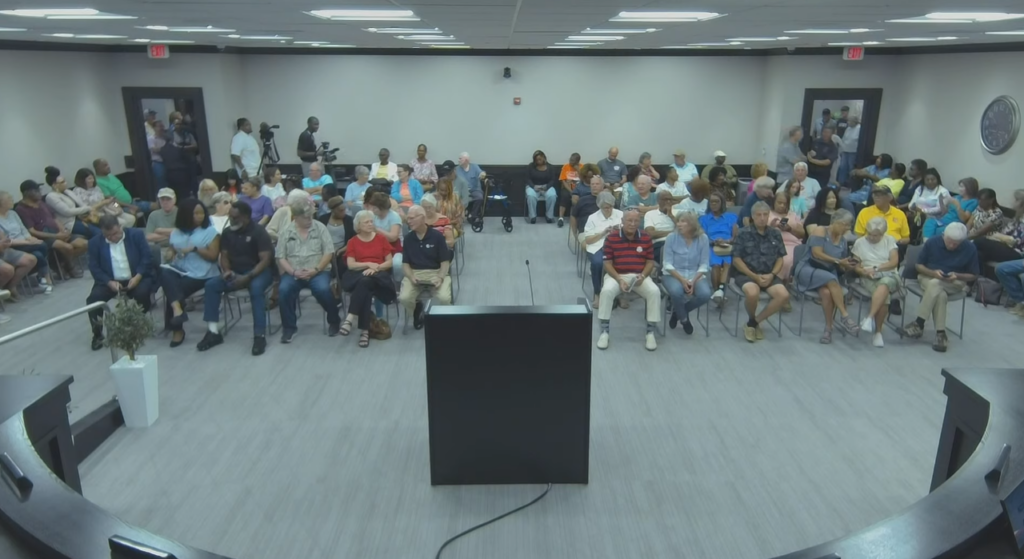
MILLEDGEVILLE, Georgia (41NBC/WMGT) — Two Baldwin County commissioners proposed smaller property tax increases Thursday as residents demanded answers about county spending and warned that higher bills could strain their family budgets.
During the first of three scheduled public hearings, Commissioner Sammy Hall proposed capping an increase at 3.5 mills. Commissioner Scott Little outlined a 3-mill increase combined with borrowing and property sales.
Those proposals are alternatives to the county’s advertised 9.3-mill increase, which would bring the rate to approximately 19.07 mills. According to the notice, that’s a 95.27 percent increase. Commissioners are scheduled to adopt a final rate September 25.
County faces year-end loan payment
Earlier this month, interim County Manager Paul Van Haute told commissioners the county had a $15 million payment due to Century Bank by December 31 and did not have the money available. He said a 9.3-mill increase was the only option he could guarantee would generate that amount by the deadline.
The borrowing is a tax anticipation note, a short-term loan used to fund operations before property tax revenue arrives.
Hall proposes a 3.5-mill cap and spending changes
Hall said Thursday that property tax collections under his proposal would more than cover the loan obligation, which he described as $15.5 million.
In response to a question from a resident about his proposal, Hall said the increase would be for one year for now.
His plan also calls for reviewing county policies, providing monthly financial reports to commissioners and publicly accounting for how general fund and program money was spent this year.
Hall proposed requiring future SPLOST and transportation SPLOST projects to wait until money is received and deposited before approval. He also called for greater use of county crews instead of contractors for road improvements.
Hall said a hiring freeze is already in place, with new hires requiring board approval. He proposed asking departments and constitutional officers to reduce their 2027 budgets by at least 3%, selling county-owned properties and hiring a permanent county manager with strong financial management experience.
Little proposes a 3-mill increase, bonds and property sales
Little said he would not support the larger increase previously discussed.
“I’m not voting for 9 mills, folks,” he said.
In a Facebook proposal he summarized at the hearing, Little estimated a 3-mill increase would generate approximately $4.8 million in additional revenue. Using $15.7 million in 2025 property tax collections as a starting point, he projected approximately $20.5 million in collections.
Little said that would cover the existing tax anticipation note and interest, with additional money going toward deferred obligations, including a Motorola payment and the county’s pension contribution.
His plan would seek bonds backed by the courthouse and government annex. It would also use a new tax anticipation note in 2027 to cover obligations and operations until bond proceeds become available.
Little proposed using the bond proceeds to repay that new borrowing, then setting aside revenue from property sales to pay the bond debt. He said his goal is to end the county’s reliance on tax anticipation notes.
Little also opposed blanket spending cuts across departments, citing staffing shortages in the sheriff’s office, fire department, roads, water and animal control.
Commissioners address spending and oversight
Hall disputed claims that the county is bankrupt or cannot account for $15 million. He blamed financial problems on unauthorized spending, failures to follow procedures and incorrect or misleading information provided to commissioners.
He said more than $2.9 million in SPLOST and transportation SPLOST spending had not been directly authorized, but expenditures reviewed so far had been for legitimate county purposes, including paving and recreation improvements.
Hall said general fund advances to those programs contributed to cash-flow problems, although those advances have since been repaid.
He also acknowledged the board’s responsibility to address the situation.
“In our case, the buck stops with us,” Hall said.
Commissioner Andrew Strickland said the board voted for a forensic audit after financial concerns surfaced late last year. He cited a county manager’s $100,000 spending authority and contractor change orders that did not require board approval as contributing factors.
Strickland said restoring public trust would require greater transparency while maintaining essential county services.
Residents demand accountability
Chairman Kendrick Butts said he wanted to hear from residents during all three hearings before presenting his own plan.
“My goal is to hear everything you have to say,” he said.
Several speakers questioned how the county reached this point and what would prevent similar problems.
Crawford Finley, who said he has taught at Baldwin High School for 16 years, challenged commissioners over their oversight.
“We’re the taxpayers,” he said. “We’re the people. We voted you in there to protect us and you didn’t. You didn’t do it.”
Tricia Clark asked commissioners to explain projected revenue, identify spending reductions and clarify how long taxpayers would face the financial impact.
“We’ve got families to feed,” she said. “I want it fixed without us having to go in the hole and me live on the street.”
Jay Wright criticized having only 10 people scheduled to speak and called for Hall, Commissioner Emily Davis and Butts to resign.
Butts said he would serve out his term and that his constituents would make that decision, “not people in this room screaming and hollering at me.”
During the hearing, Butts also asked a woman who repeatedly spoke out to leave. A deputy escorted her from the room.
Another speaker, Ricky Giles, thanked commissioners while urging them to cut spending as much as possible. He also recommended choosing a permanent county manager from Baldwin County.
Remaining hearings and final vote
The remaining hearings are scheduled for 10 a.m. Friday, September 18, and 10 a.m. Friday, September 25, at the Baldwin County Government Building, 1601 N. Columbia St., Suite 220, in Milledgeville.
The final hearing will be followed by the scheduled millage adoption.
Watch the September 17 public hearing on the commissioners’ YouTube page.