Orion crew prepares for far-side moon flyby in historic Artemis mission
The maneuver will give astronauts one of the clearest and widest views ever captured of the moon’s far side.
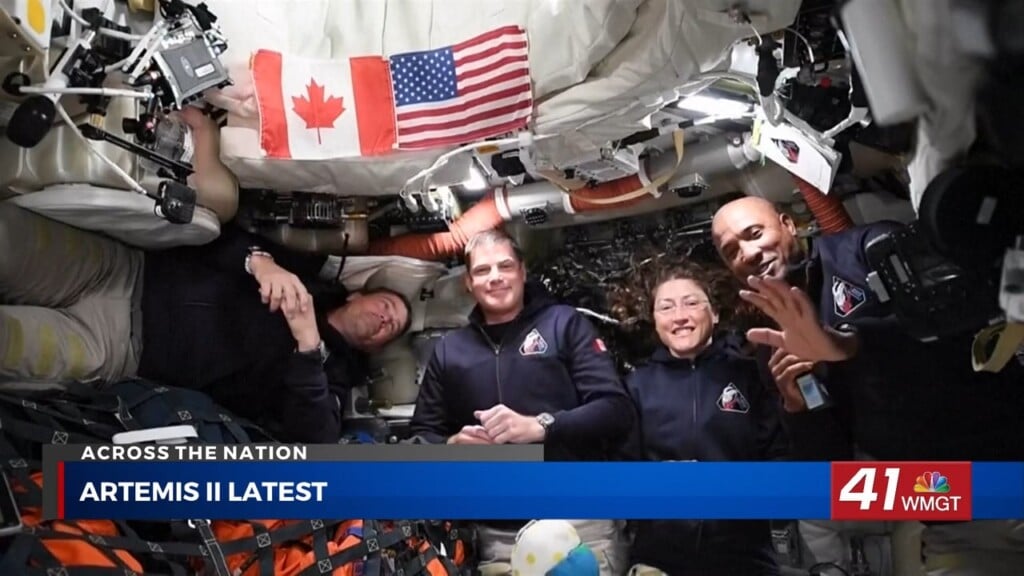
(NBC)- The countdown is on for a historic moment in space exploration as NASA’s Orion crew prepares to fly past the far side of the moon, marking a major milestone in the Artemis program.
The four astronauts spent Easter traveling deeper into space, sending back images of Earth as they continued their roughly 252,000-mile journey toward the moon. During the trip, the crew also conducted a critical safety test, wearing pressurized orange survival suits designed for emergencies such as cabin decompression.
Mission control says everything has been building toward Monday’s flyby, when Orion is expected to pass between 4,000 and 6,000 miles above the lunar surface. The maneuver will give astronauts one of the clearest and widest views ever captured of the moon’s far side.
For about seven hours, the crew will work in pairs to photograph the lunar surface. The spacecraft is scheduled to make its closest approach to the moon at 7:02 p.m. Eastern, followed just minutes later by its farthest point from Earth at 7:07 p.m.
Later in the evening, at approximately 8:35 p.m., the moon will eclipse the sun from the crew’s perspective — another rare and visually striking moment during the mission. The flyby is expected to wrap up around 9:20 p.m.
As Orion passes behind the moon, mission control will temporarily lose communication with the crew for about 40 minutes — a planned blackout known as a loss of signal. NASA officials say this is expected and not a cause for concern.
Despite the distance, astronauts have remained in contact with Earth leading up to the flyby, sharing their emotions about the journey. Canadian mission specialist Jeremy Hansen described the experience as humbling, noting the rarity of humans traveling so far from Earth.
NASA astronaut Suni Williams, who previously spent 286 days stuck in space, emphasized the importance of test missions like this one, saying they are essential to understanding how systems perform in the harsh environment of deep space.