Georgia’s American Journey: Fort Hawkins tells story of Macon’s early frontier days
Built in 1806, Fort Hawkins served as a frontier military post and helped spur the early settlement that became Macon.
MACON, Georgia (41NBC/WMGT) – As America marks the 250th anniversary of the signing of the Declaration of Independence, we want to look back and highlight some of the important places and people here in Middle Georgia who have helped shape both our state and the country as a whole.
This week we are exploring Georgia’s American journey with one site that stands out as a cornerstone of local and national history: Fort Hawkins.
Built in 1806 by the U.S. Army—just three decades after American independence—Fort Hawkins was established as a military outpost on the edge of the young country’s boundaries, overlooking the Ocmulgee River. According to Dr. Gazaway, archaeologist and lab director at Fort Hawkins Foundation, it’s one of Macon’s “undiscovered treasures.”
“It’s where the history became this perfect story,” Gazaway said. “This is what attracted people here, causing the settlement to build up and actually create the city of Macon.”
Krystle Freeman, chair of the Fort Hawkins Foundation, says its origin tells a story of strategic purpose and frontier life.
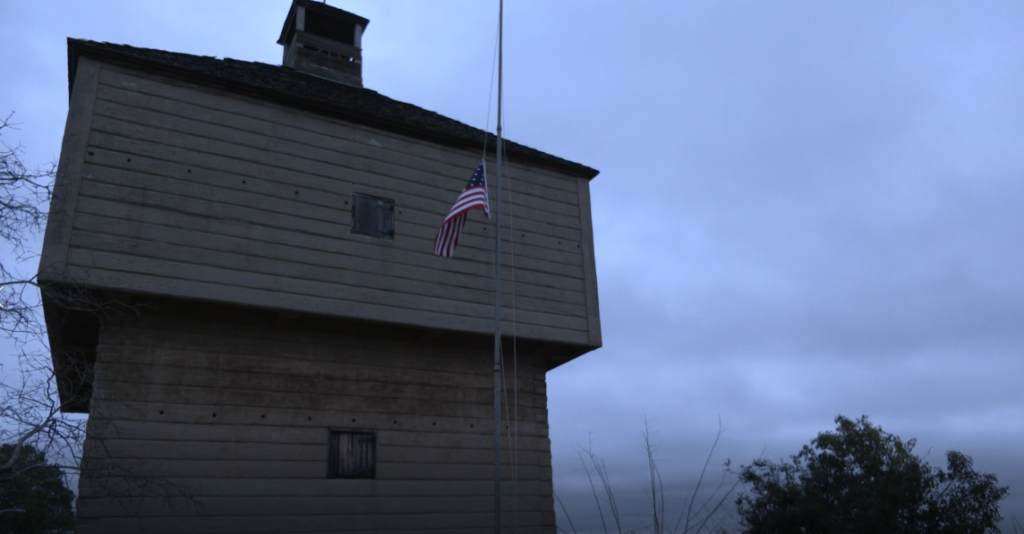
“1.4 acres was turned into the fort and enabled us to look over, in the absence of the buildings, you could see pretty much everything around the entire place at the top of the blockhouse,” she said.
“This is where it all began,” Gazaway continued. “Once you crossed the river, you were in Creek territory.”
Fort Hawkins served multiple purposes in its early years. It was used as a military hospital for three years, and during the War of 1812, the site became a hub for some 3,000 troops who arrived from across the country. The influx of soldiers and settlers led to the creation of Newtown—a precursor to the city of Macon—as people sought homes and opportunities beyond the cramped boundaries of the fort itself.
The fort became a vibrant center for trade and business. For a time, it was home to a thriving fur trade, with Native Americans and settlers exchanging goods for prized pelts that would eventually make their way to Europe. The site also served as an important administrative hub, where settlers secured paperwork to enter or leave the United States. Over the decades, Fort Hawkins has witnessed dramatic change: from plantation land to an artillery battery for the Confederate Army, to a baseball field in the early 1900s, and later as the site of Fort Hawkins School and Dewitt McCary Park.
Gazaway says the surrounding land was highly productive for agriculture in the 19th century—a tradition that continues in the region today.
“Manufacturing came in here,” Gazaway said. “This was right on the fall line. From here north, most of the rivers are not navigable, but south to the ocean, you can still use the rivers for transportation of goods.”
Efforts to preserve and rebuild Fort Hawkins began in the 1920s, but it wasn’t until 1937–1939 that the Works Progress Administration and the Daughters of the American Revolution completed and dedicated the blockhouse replica that stands today.
Now, Fort Hawkins continues to educate and inspire new generations. The site hosts a Junior Docent Program, training young people aged 10 to 18 as junior historians and archaeologists. Participants learn about flag history, the region’s past and the everyday life of those who came before.