The Douglass Theatre – Georgia’s American Journey
Opened in 1921 during segregation, the theatre provided a safe space where Black performers and audiences could gather at a time when access to entertainment venues was severely limited.
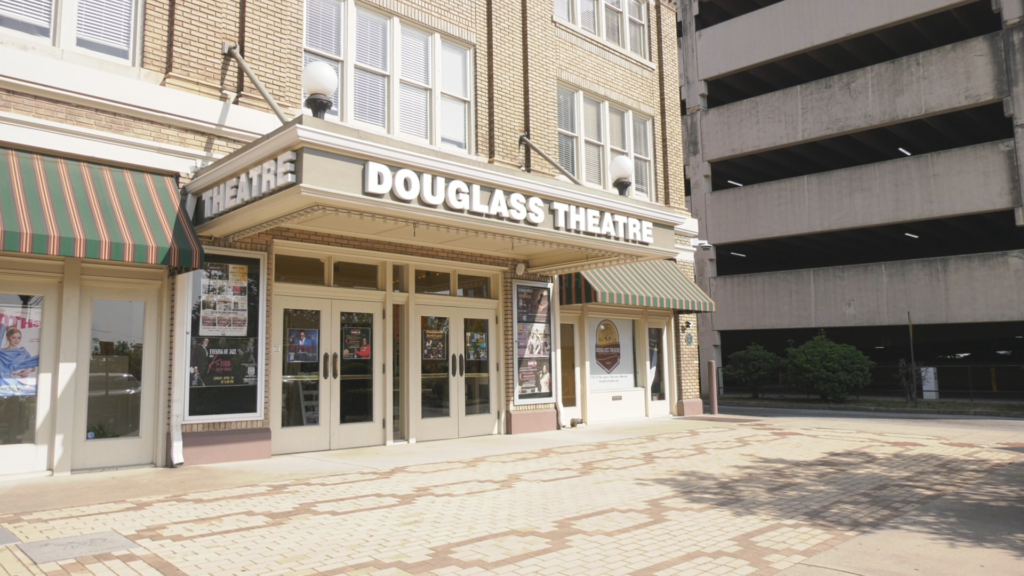
MACON, Georgia (41NBC/WMGT) – In downtown Macon, the Douglass Theatre stands as a powerful symbol of African American culture, entrepreneurship, and artistic expression.
Dr. Shelton Land, Executive Director of the Douglass Theatre, says the venue filled a critical gap in the community.
“Afforded black people access where they didn’t have access to other places and you think about segregation in 1921 limited spaces where African-Americans could go and feel safe and thrive and so the Douglass provided that platform where artist could come share their creativity and feel safe while doing it,” Land said.
Named after Frederick Douglass, the theatre quickly became a hub for Black entertainment, hosting performances from artists who would go on to shape American music.
“I think everyone knows that Otis Redding this was his stomping ground here catapulted him and he launched as he kept winning the teenage party and then you have the James Brown the Little Richards you have the Cab Callaway‘s the Ma Rainey the Betsy Smith’s all of them flow through The Douglass,” Land said.
The theatre was founded by Charles Henry Douglass, one of Macon’s first African American millionaires. After his death in 1940, his wife, Fannie Appling Douglass, continued running the theatre for decades, helping expand its influence.
“Charles Henry Douglass, you know started at the theater him and his wife Fannie Appling Douglass people don’t talk about a lot. You know Mr. Douglass died in 1940 but his wife ran the theater for 30 years after he died from 1940 to 1971 and it was doing her era that it became a Mecca of black entertainment, Mr. Douglass, you know he was the roaring 40s and the silver screen, but for them to come up with this idea and to see that comes to fruition and still standing and being in a cultural touchstone for Macon I think the vision was clear we wanted this to be a venue not just for performances, but to serve as a voice for the people,” Land said.
Land also highlighted the significance of the couple’s success during segregation.
“He was Macon’s his first African-American millionaire and so when you think about that and how he was able to navigate during an intense time of racial segregation, you know I can’t even think about the 1921 when you think back in 1921 how did a black man have so much power but you know I said it always comes in twos so it wasn’t just him. It was him and his wife and Fannie Appling Douglass who’s actually connected to the Appling family where her brother was a Professor Peter G Appling, there’s actually a middle school named after him,” Land said.
Today, leaders say the theatre continues to play a vital role in the community.
“The Douglass serves as a beacon of what Macon can be. It also represents the history of Macon when we talk about our city in general when it comes to black entrepreneurship when it comes to black arts when it comes to even preserving black stories, The Douglass is a place for good stories and a place where we’re able to continue the legacy of Macon,” said Weston Stroud, Vice Chairman of the Douglass Theatre Board.
Stroud says the theatre is also focused on reaching younger generations through programming and education.
“One of the things that we do is that we engage the youth where they’re at so we have a hip-hop summit that Vince Muhammad host every year. We also have our summer camps where we teach the students about tech theater tech as well as the arts in the theater and so really what we do is we meet them where that instead of trying to tell them about history and make history the main focus you make understanding them, the main focus and allowing history to kind of find its place within the things that they love,” Stroud said.
Leaders emphasize that the theatre’s impact extends beyond entertainment, serving as a unifying force in the community.
“For art, arts always brings people together. I think art is freedom art don’t see color, race, gender, art is art and so when you think of a performing arts and a space like this is a cultural treasure and so it’s important for a place with Macon being in a deep south during that time back in the day, like when it was heavy racial tensions, and how this could be a space where that could provide solidarity across the community,” Land said.
As the United States approaches its 250th anniversary, Stroud says the Douglass Theatre reflects a larger American story.
“When I think about America and it’s long history, I think The Douglass is a representation and honestly an alliteration of the the story of America when you talk about a man coming from nothing and creating something and then creating a cultural hub that’s the story of America people came here with nothing and tried to create something,” Stroud said.
From its beginnings during segregation to its role today as a cultural landmark, the Douglass Theatre continues to stand as a testament to resilience, creativity, and progress in American history.
This story is part of Georgia’s American Journey: 250 Years, a 41NBC series examining Georgia’s history and its lasting impact on the United States.
Click here to explore more stories, videos, and features from across Middle Georgia.